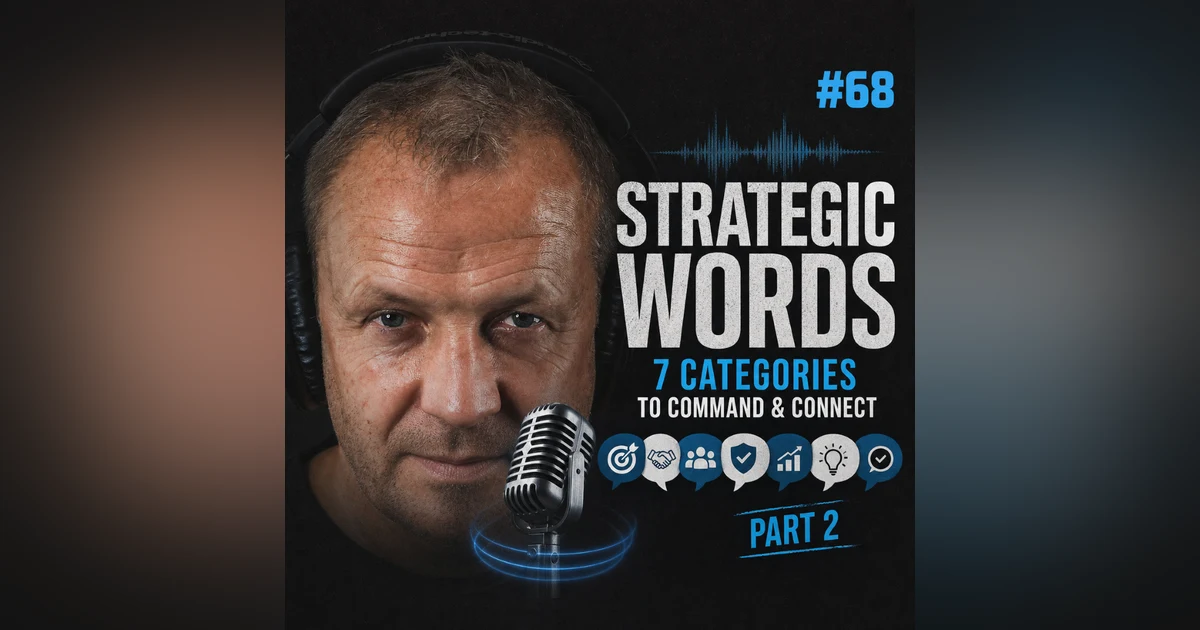
#68 Strategic Words: 7 Categories to Command Authority and Build Trust with David Goldberg (Part 2)


 Apple Podcasts
 Spotify
 RSS Feed
 Amazon Music
 RadioPublic
 Did you know that your audience decides whether to trust you, like you, or do business with you in just a quarter of a second? In Part 2 of our exclusive 5-part series with David Goldberg, CEO of Edge Studio, we dive deep into the "Strategic Words" that define your professional presence. David reveals the seven critical categories of wording that can either elevate your authority or quietly sabotage your message. From the psychological trap of "hedge words" to the simple shift from "but" to "and," this episode is a masterclass in intentional communication. Whether you are a podcaster, a business leader, or a public speaker, David’s insights will help you ensure that your first impression isn't just good—it's unforgettable. ⏱️ Timestamps 0:00 Welcome & Introduction to David Goldberg 1:26 The Power of the First Impression: Why a quarter of a second matters 3:15 The Science of Swift Decisions: From grocery aisles to podcasting 4:50 Introducing the 7 Categories of Strategic Wording 7:56 Category 1: Being Interactive — The right and wrong way to ask questions 9:22 The "Show-Off" Trap: Why you shouldn't ask questions your audience can't answer 12:41 Visual Presence: Camera angles, hand positions, and the "fingertip" mistake 14:35 Category 2: Avoiding Hedge Words — "Probably," "Maybe," and "I think" 16:13 Strengthening Your Message: Replacing "I think" with "I believe" or "I know" 25:57 Category 3: Avoiding the Word "But" — How it negates everything you said before 27:11 The "And" Solution: Maintaining positive momentum in conversation 29:03 Category 4: Positive First Word Responses — Using "Exactly," "Absolutely," and "Yes" 30:14 Category 5: Avoiding Interrupting Yourself — Staying on track and finishing your thoughts 36:31 Category 6: Avoiding Filler Words — The "Um," "Ah," and "Like" habit 43:26 Category 7: Organizing Your Content — The importance of a clear roadmap 55:56 The "Fine" Example: How prosody (tone) changes the meaning of words 68:48 How to Connect with David: EdgeStudio.com and the "Roy's Shows Rock" subject line 69:22 Looking Ahead: Preview of Session 3 69:51 Outro: RoyCoughlan.com and the PodFather Network 🔗 Where to Find David Goldberg •Website: EdgeStudio.com •Email: David@EdgeStudio.com (Mention "Roy's shows rock" in the subject line for a responsive reply!) •Location: Times Square, NYC 🔗 About Your Host (Roy Coughlan) •Listen to this episode on Podbean: https://podfather.me/e/david-goldberg-strategic-words-part-2/ •Explore more podcasts: Find all podcasts at the PodFather Network •Website: RoyCoughlan.com •Need help running your business? If you are looking for a Virtual Assistant and get reliable support for your daily operations. •Virtual Assistants: VA.world •Communities: BrainGym.fitness •Private Networking Group: Learn about a Private Networking Group in 50 US States & 39 Countries with 640+ Members https://connectedleaders.academy/ #Podcasting #DavidGoldberg #EdgeStudio #StrategicWords #FirstImpressions #CommunicationSkills #PublicSpeaking #AudioQuality #ProfessionalDevelopment #LeadershipCommunication #RoyCoughlan #PodFather #ContentCreation #VoiceoverTraining #BusinessCommunication
Welcome to the Podfather podcast. You can find all the references on podfather.me. Find everything about me, scan the QR code, go to roycolin.com, find my six shows, along with everything else I'm doing. Today, I'm delighted to be speaking with David Goldberg.
Again, we had a fantastic conversation the last time. He's the founder, CEO, and chief Edge officer of Edge Studio, which can be found at edgestudio.com. He is an internationally recognized voice director, speaking coach, author, and presenter, who has helped over 10,000 professionals sharpen their communication presence from C-suite leaders and politicians to authors, podcasters, and entrepreneurs. And today, we're gonna be talking about making a good impression and strategic words, which are very important.
Delighted to have you back, David. Thanks. Thanks for having me back.
I really did enjoy our first conversation. Thank you. Yeah, so did I. This is also, I mean, I suppose making the first impression and the words we use, it's something that's, because I've done the Toastmasters, done hundreds of speeches and everything, and I was mentoring people and seeing it, I can see straight away, people will lose it or they grab their attention.
And it's the power of words and just how you do it. And I know you've got incredible experience. So where would you like to take this off? The first thing to talk about is truly the power of first impression.
There is the craziest research done on first impressions. You should all go online and search this up. What happens in a first impression? And how long does that first impression take? And some of the studies show that in a quarter of a second, just a quarter of a second, internally, you decide whether or not you like someone.
Whether or not you would trust them, whether or not you would want to do business with them. And for all the people out there who create podcasts, that means in that quarter of a second, your listener decides whether or not you're worth listening to. So first impression is super important.
And over the years, I've looked at different ways to make that first impression stronger. What can you do right from the outset in a quarter of a second to let people know that, okay, you're worth my time. I've taken my time and I'm going to sit down and listen to what you have to say.
It is so easy for people to switch from one podcast to the next or one TV station to the next or one song to the next. You need to do something so you increase your listener engagement. And that can, to a very large degree, be done with your words.
I call it strategic words, in fact. What words do you say up front that grab someone's attention? And that's what I think would be super fun to talk about. And like if you had asked me, I would have thought maybe three seconds, 10 seconds.
But if you're saying half a second, I presume it's our intuition that's actually subconsciously doing this. Yeah, it has to be intuition, gut, DNA, hunches. I don't know what goes on in our bodies, but something tells us.
And when I first read that statistic, I thought, really? Could it be a quarter of a second? But after I first read that, I realized that as I go around in everyday life, I do make really swift decisions. It could be at the grocery store as I'm looking for something to purchase, I just quickly scan until something catches my eye. I might scan a whole aisle of ketchup bottles.
I don't even eat ketchup, but like 20 kinds of ketchup. And it's probably within a second or two, so I just kind of quickly scan and something grabs my eye. That means I'm looking at 20 different kinds of ketchup in a second or two seconds.
But one of those bottles is gonna grab my attention. Is that bottle shinier, taller, shorter? Something about it just catches our eyes. And same with people, same with music.
I listen to even my kids when they are switching songs, when they're listening to their, I was about to say iPods, which is such an old technology, iPhones. And they're looking for something to listen to. They're like one second, one second, one second.
They just click around so fast. And yeah, we do make very, very swift decisions. And a lot of things go into that swift decision.
It's your sound quality, your lighting, your camera angles. Those are things we talked about last time. A lot of it is your words.
So again, yeah, let's talk about strategic wording. I think there are seven different categories of wording that we can talk about. So I'd like to list those seven types out and then we'll go back and talk about each one.
And I have some slides coming up. Number one, I think being interactive with your words is super important. Number two, avoiding hedge words.
Side note, most people don't know what hedge words are. And I will explain. The funny thing is earlier in this presentation, I used the hedge word.
And as I said it, I thought, oh no. But time and place for everything. Number three, avoid the word but.
That's but with one T, not two Ts, by the way. Number four, use positive first word responses. Again, I will explain what all of this means.
Number five, avoid interrupting yourself. Number six, avoid filler words. And number seven, organize your content.
Those seven things, I believe, are ways to strategically use your words so you maintain the listenership, the listening engagement of your listeners. So, okay. Before I launch into the number one, Roy, any thoughts, any questions? Well, what I was thinking, because I mean, obviously, whether they're podcasters or people doing their business, both audio and video.
And I would think a smile as well would be important because if you see somebody who's kind of like, you know, not as happy as the two of us, you know, it's like, it depends on the mood you're in. But you want something that kind of lightens your day. So I think even how you come across within the first second as well.
Absolutely. Presence is a huge part of this, yeah. Something I would love to talk about in a future episode.
The areas that I study are three, wording, talking, and presence. Those three categories are ultimately how we come across, how we come through, how someone perceives us. Those three items are the big categories.
Yeah, absolutely essential. And so today we talk about words. That second category of how we say those words is equally as important because you could have a great word, but say in a kind of a yucky way, and it doesn't come across super nicely.
It's like the word fine. The word fine is interesting. I could, for example, my wife could say to me, how do I look? I could say, oh, you look fine.
Meaning she looks great today. She could also say to me, how do I look? And I could say, yeah, fine. And it doesn't mean nearly as much.
The same word, it can have a very different connotation. So yeah, it is wording. It is how you say those words, which is called prosody, and your presence.
And those three things together equal how we come across, how we come through. Okay, with wording. The first item I wanted to talk about was being interactive.
If you want to grab the attention of your listeners, make sure you are interactive to some degree. You and I are conversing back and forth, which is super interactive. If you are on a podcast solo, then ask your listeners a question.
Ask them something that gets their mind spinning. Even one short question can make that conversation interactive. However, there's something really interesting.
You mentioned Toastmasters. I'm not putting down Toastmasters. Toastmasters and almost every other public speaking coach, truly, all of them out there, talk about being interactive.
And beginning a presentation with a question, because it's interactive, it pulls in people. But I kind of feel a little differently sometimes. A lot of the questions that I see people use at the beginning of a podcast are questions that the listeners could not possibly answer.
And when you ask a question that no one else can answer in order to grab attention of the listener, there's no way that, because there's no way that they can answer that, then they have to say to you, well, I don't know. And you say, well, here's the answer. And the way that comes through is that you are a show-off.
And one way to turn people off is to show that you are a show-off. I could have started this podcast by saying, guess how many people don't smile when they begin a podcast? There's no way anyone out there could know the answer to that question. And maybe I've researched that.
Maybe I haven't. But regardless, if I ask a question that you can't possibly know the answer to, then when I tell you, ah, the answer is 3 million, then it's just me trying to be better than you. And what I'm doing is I'm setting myself apart from my listeners.
I can't imagine why a presenter, whether a podcaster, a keynote speech, a public speaker, I can't imagine why anyone in that position would want to set themselves apart from your listeners. You want to be engaging. You want to be interactive.
You should not set yourself apart, but instead join them. So ask a question that people might actually know the answer to, or something they could take a logical guess at. Again, it's a great way to begin a conversation, ask a question, but make it something that they can join in and make it a conversation.
So there's another thing as well that I've seen people do. And what it is is they'll ask a question and they straight go in. You have to give a few seconds for your listener to contemplate the answer, because you've lost me if, like for example, if you had said about the three seconds as that was the question and just went straight into it and just left a few minutes, people kind of, within a second or two, they have an answer, but sometimes people don't even give that.
Yeah, I reviewed a presenter, I think it was last week. And in her presentation, as I worked with her, she kept asking questions to herself and then answering them. So for example, she'd say, so why am I here? Well, I'll tell you why I'm here.
And later on she said, so what do I have to talk about? Well, I'll tell you what I have to talk about. And that was- There's a lot to that, there's a lot to that. Yeah, they do, yeah.
Yeah, it's become sort of a common way of speaking. It may feel good to say it that way, everyone, but it doesn't come across good to the listener. And that's the key thing.
Unless you pull out a puppet, then it looks okay if you do it that way. Sure, I'm not doing it that way. Repeat that more clearly.
Oh, was it unorganized? Yeah, yeah. It's really important to everyone when you're recording a podcast, giving a speech, giving a presentation, a customer presentation, an investor pitch, a media interview, an elevator pitch, when you're leading a seminar, speaking with a prospective client, when you're on an interview for a job, in any situation when you're talking and your words are important, be interactive for sure, but in a friendly, easy way that people can converse with you. That is just absolutely important.
Remember, don't set people apart from you. Bring them in, join them. Okay, the second item on the list.
Actually, let me go back. Roy, any other questions or things to talk about? I mean, if we're talking about even, say, stage or whatever, because sometimes people, they're just sitting position, you know, like you. I mean, I'm always kind of forward like that.
You're standing, that's the setup you've got. But you see people, and I've seen it in interviews. I mean, I've interviewed loads of people even when I was working.
You see people like that, and the same with the podcasters. And it's like, not only your diaphragm, but it just looks wrong. Yeah, there's so much to that.
One thing, when you are online, as we are, think about your square. Make sure that your head fills up that entire square. Yours does, and you have an amazing background.
When we got off the podcast last week, or I think it was earlier this week, in fact, Monday of this week. Monday, yeah. After the podcast, I said, Roy, I really like your background.
The display looks great. My background simulates a recording studio, which is what I spent my life in in New York City. And so we all have backgrounds that should support us.
Also think about where your hands are. Roy, when you use your hands, we see your whole hands, and that's good. Sometimes people position their cameras and their angles, and so all you see are fingertips coming up.
I'm trying to simulate that. Like, here's, you see my fingertips just? And so you see like this all the time, little fingertips going up and down, and that's really distracting. So make sure that you do use your body, but either set up your camera so when you use your hands, you see all the hands, or you don't see hands at all, but it's weird to just see fingertips like that.
Just as you're on the camera, what I had this week, and it was strange, because newer cameras, it kind of reacts and it zooms in. So the person was talking to me, and she does something next, the camera zoomed right in, so it was like in her face, and then later it kind of went up, but then I could see that she was trying to move her hand moments to get it back because it didn't look right. So sometimes people with the best technology, there's times, I don't know, are you able to turn off that feature, but it doesn't serve you well unless you know how to use it.
Yeah, the auto-focusing or auto-movement, I guess we'd call it. Auto-movement, it was just zooming in. It was all clear.
It wasn't that it got blurred, but it just, it didn't look right. Yeah, yeah, I shut it off on every device I have. Yeah, I think in all the calls I've had, I had it on one call.
I was on one call once, and I knew that I'd be kind of moving around, and I thought, oh, let me turn it on. It was a unique call where I had to walk around, literally walk around, and I had a headset system on, and so it made sense, but that was the one time I've ever used it. Yeah, I would not use it right now.
People get vertigo when you watch someone. You know, when you're the person moving, you don't notice the camera moving with you because you are moving, but to your audience, yeah, it's distracting. It really is distracting.
It's like the Blair Witch Project, like. Yeah, exactly. I remember those scenes clearly, running through the forest and everything.
Yeah, it's a very fun analogy. Okay, so the second thing I mentioned I wanted to talk about is they're called hedge words. Hedge words are words that lessen the certainty of something.
Hedge words take what you intend to say, and they make them less relevant. I don't know why you would ever want to do that when leading a seminar, running a podcast, trying to influence someone to buy your product, to hire you. Here, you want to be confident, come across confidently.
However, hedge words, they distract from that. They weaken your message. Hedge words are words like probably, and maybe.
I probably should do that. Maybe I could do that. I should do that.
I think we can do that. All of those words are hedge words. Interestingly, in the early part of the conversation, I used the word think.
I said, I think there are seven things I want to talk about. And as I said, I think, I was thinking. That's when I should have said, I believe, or I know.
Or I should have just said, there are seven things I want to talk about. Listen, in fact, right to the difference of that statement. I could say, I think there are seven things I want to talk about, versus, there are seven things I want to talk about.
Yeah, the second one's 100 times better. Exactly. And I threw in the word think, and I really work hard on not doing that.
Interestingly, in everyday conversation, we all tend to use hedge words all the time. It's become second nature to us because it's so common. We hear other people do it.
We're influenced from our parents when we learn to speak. Our parents' parents did it, and their parents probably did it. I don't know how many generations back it goes.
Nonetheless, it's a very hard habit to break. However, when you are running a podcast, if you want to come across confidently, if you want people to listen to you talk for an hour, or give a speech or a presentation, and walk away saying, that person is on top of their game, that person knows their stuff, I would trust that person. If I was an employer, I would hire that person.
If I was shopping for a coach, I would hire that person as a coach to do business with them. If you want any of those things to happen, avoid hedge words. It's an amazing difference, like that one example that we just ran through a moment ago.
In a few minutes, I'd like to show you some slides and show you examples of hedge words. Examples, in fact, examples of a sentence when there is a hedge word, rather, and then removing the hedge word. It's really, it's pretty cool.
So we'll get there pretty soon. Third thing- Just on that before you jump, this is what I've noticed, and it's usually people that are doing the lives on like Instagram and things like that. But a lot of people, and I know I'm guilty myself, they start off the sentence with, so.
No reason for it. So, da, da, da. So today I'm going to talk about her.
I'm going to talk about her. There's a very high percentage of people that use that. It is astounding how many people do that.
I often teach classes on how to interview, how to be interviewed, I should say. I teach this class to a lot of high school and college kids who are going off to apply for college, interview, rather, with college recruiters. They're interviewing for internships for first jobs.
I teach interview skills classes for adults who are transitioning from one career to another or looking for a promotion. And 99%, I guess, say every sentence begins with a so. It is amazing.
And one of the things we talk about is the interviewer may interview 10 candidates or 50 candidates for a job, 100 candidates for a job. And if each interview has 10 questions and you have 100 candidates, that's 1,000 times they ask a question and 1,000 times someone starts with so. That answer, it drives them nuts.
In an interview, the potential employer can ask the potential employee, why are you interested in this company? Why are you interested working here? So I'm interested in it, and there's that word so. Yeah, it's interesting. Third thing on the list, get rid of your buts.
Seriously, but is a negative word. Yet we all use the word but when we don't mean anything negative. But why? But why? I will tell you off the bat, the best thing you can do when you speak is change the word but to the word and.
For example, I could say, this podcast is going well, I'm enjoying talking with you, Roy, but I have to get going. As soon as I say the word but, there's a negative feel. If I was to say, I'm really enjoying talking with you and I do have to get going.
I'm still communicating the same thing. I've enjoyed my talk with you and now it's time to go, but there's no negativity in it. It makes a big difference.
Someone at work might say to their boss when interviewing for a promotion, I've been working here 10 years, but I've been working really hard in those 10 years. Why not say I've been working here for 10 years and I've been working really hard. Change the word but to the word and.
It transformed how you come across. If you are keen enough to catch yourself saying the word but, you'll probably notice that you say it in every paragraph. In other words, every three, four or five sentences, there's going to be a but.
And work hard to catch that and change it to the word and. And instantly, things seem more positive. And when you are more positive, you come across way more effectively, way more engagingly, which is the point of all of this.
You want these strategic words so people do stay tuned, they do stay engaged, they do continue to listen. So change the word but to the word and. There are definitely times to use the word but.
Sometimes you need to be negative. There's a time, there truly is a time and place for everything. But I will venture to say that nine out of 10 times, the word but can be changed to the word and, and it does make sense.
So what you should do is, when you say it, slap yourself on the butt, and then you don't want to be doing that in public, and that'll make you to stop doing it. And I use so, there, no. To start with, that's it.
And I was conscious as soon as I said it. I was like, why did I do that? Absolutely. It's the patterns though.
It's when you say it so many times, that's the problem. I like the idea of slapping everyone in the butt. I think this whole society would walk around hitting themselves in the butt all the time.
Yeah. We get echoes like, but, but, but, but, but. Okay.
That's why, maybe that's why the word but for your rear end has two T's. It echoes back and forth. That'd be right.
That would be like sliding down the stair banister, sitting sideways. You get like a sound. Okay.
Next thing on the list. The fourth thing on the list is positive first word responses. This is something I think you should all write down.
Positive first word responses. Every time you begin speaking, try to use a positive word. Try to say something that is exciting, grabbing.
Roy, if you look at the emails I send you, I bet every single one of those emails, every sentence begins, the first sentence rather of every email begins with a great or a yay, or I'm excited about talking with you tomorrow. There's always something at the beginning. When I write emails or when I give speeches, I think about that first sentence.
If I'm writing the email, I go back and I read it again and I make sure there's something positive in the beginning. I might write to someone and say, we need to speak at nine o'clock in the morning. But then I will go back and say, hey, good news.
We have to speak at nine in the morning. I can't wait to share something with you. Something positive in the beginning makes a big difference.
That catches people's attention and it keeps them listening. If you don't begin with something positive, they are very likely to not read whatever it is that you have to say. If you want people to be receptive to your messages, if you want them to listen, to stay engaged, use positive first word response.
I know that not every situation is positive and sometimes this doesn't make sense, but the vast majority of times, this is a great way to get in. If you have someone that you've been trying to get a message to and they just never respond to you, they don't call back, they don't write back, whatever it is, try using a positive first word response. Put something exciting at the beginning.
I have a bunch of examples to show you when I share my screen. That's fascinating. And what I would just like to say on that, I know it's not the first word, but based on emails and things, it's a brilliant tip.
Couple of years ago, somebody said to me that we're signing emails with like your sincere, kind regards and stuff like that. But when you're having a conversation, you never say something like that. So I changed it to greetings.
And it's the same kind of thing. Sometimes it's different if you're writing somebody a letter and you're posting a letter, which I don't know, does anybody do anymore? But it's like, would you ever say your sincere, kind regards to me? You know, it doesn't. And I think keep it more human and like both the start and the end, I think have a big impact.
I don't typically write emails by typing. I turn on my mic and I transcribe my emails because there's a huge difference between written English and spoken English. They're so different in so many different ways.
For example, written English has lots of punctuation marks, spoken English doesn't. Written English can be very formal, your regards, best regards and things like that. Spoken English, yes, we never say that stuff.
So I take pride in transcribing my emails because I want my emails to sound like spoken English, not written English. Even though I am writing them, I write them in spoken English. They are almost like two different languages.
And I choose to come across in an informal, everyday, casual, spoken way. My whole world is about spoken English, spoken language, truly. And so I want everything to sound like it's spoken.
It's interesting, when you transcribe someone, when you transcribe someone talking naturally and you put it next to a letter that they had written by typing the words out, it has a completely different vibe. That email where they transcribe it is just fluid and way more readable. People do read an email that's written in spoken English, more readily than they would read an email that's written in written English.
Interesting. Okay. And I think it's the same in a book, actually, because sometimes there's people that are speaking a lot and people love what they're saying, but they're not putting it into the words like that.
They're putting it into the way they think people would like to be reading it. And there's even ghostwriters, they do it wrong. Like the person might transcribe like the way you said it, but then they're putting it into words the way it should be in proper written English.
And that's why some books aren't taking off like they should. Very true. In everyday conversation, we have lots of descriptive words and we have lots of, let me think what else we have.
Lots of colloquialisms, I'll use that word, contractions and colloquialisms. And when you add those to your written English, your written language, yeah, it does come across more favorably. It just is engaging.
I'd like to share my screen if that's okay, Roy. Absolutely, yeah. Just as you're setting that up.
I mean, when I'm sending, engaging with people, whether it's WhatsApp or Facebook, I prefer leaving a voice message because so many times people get the wrong impression from the way it's written. But like you said, like you were giving an example earlier, when you say it in a nice way, I know that you don't mean it bad, but sometimes when the words are written down, they just, it's how they interpret what you've just written. And that's why I prefer sending a voice message.
Right, exactly. Yeah, when you speak, you really control how your words land, much more so than when you write. Because when you write, there's only one opportunity to convey your emotion and that's the word choice.
But when you speak, there's the prosody of your voice. It's your timing, your intonation, your spacing, your pacing, the emotion in your words, the hesitance in your words, the colloquialisms in your words, the spontaneity, the authenticity of human voice. There's so much more.
And take that a step further when you are in front of an audience, then you also have body language and how you come across. That's when you communicate the best, when you're visual with someone. Okay, on the screen is this very basic situation.
A new customer asks if you can complete a project by Monday end of day. I get this all the time in our office. Clients call and they say, we have a recording we need done.
Can you do it by tomorrow afternoon? We have a big project. Can you get that done by next Tuesday? And that's what clients typically ask. So imagine everyone that you are asked the question and it's a really big project.
You think, and I want to use the word think here, you think you can do it, but it'll take some preparation. So here's what typically people would respond. Some people would say, yeah, I think we can do that, but it'll take some preparation.
Let's examine this sentence for a second. Yeah, I think. There is that hedge word, I think we can do it.
I think the customer would feel a lot more assured that you could do it if you said, I believe we can do it. And it would feel even more assured if you said we could do it. It's a big transition from I think we can to I believe we can to yes, we can.
If you are selling, any of you out there, if you sell a service, a product, or you are a coach or whatever service or product you sell, think about how your words land to your listener, to your customer. Further in this sentence is the word but. There's that negative word but.
Instead of saying, I think we can do that, but, how about say, we can do it, and it'll take some preparation. And it will take is positive versus but it will take. The moment someone hears but they think negative territory.
I can't imagine why you would want to do that with a prospective customer or a prospective employer. Or if you run your own podcast and you have listeners, why keep going into the negative when you can keep it into the positive? The third thing here is positive first word response. The first word here is yeah.
That's not a negative word per se, but certainly there are stronger positive first words that you could use, like the word absolutely. If I said, absolutely, we can do that, that means a lot more to you than, yeah, I think we can do that. Absolutely, we can do it, and it'll take some preparation.
Watch this slide. Here it is, say it better, over here where my cursor is. Absolutely, we can do this, and I look forward to taking some time to carefully prep for it.
What a difference that is. Massive. To take away the bottom here, we are avoiding hedge words, replacing but with and, and using positive first word response.
I always mention this number 98%, do you see here where my cursor is spinning? Yeah. That 98% is not an accurate number, so you may question why am I putting it here. I'll tell you why I'm putting it here.
It may be accurate, but I'm not sure, and that is a but, that's a negative, because I'm not sure. I went into search engines, and I said, how much more effective is someone when they speak, and they avoid the word but? And the search engines had some number, like we were 120% more effective, whatever the number was, I don't recall. And I asked search engines, how much more effective are you when you avoid hedge words, and there was a number.
And how much more effective are you when you use a positive first word at the beginning of your sentence, and there was a number. And I averaged out those three numbers, and they came to 98%. That's not a scientific 98%.
That's a David Goldberg, who doesn't know much about math, averaging three numbers together, and I got 98%. Whatever the number is, you will be significantly more effective if you follow these things. Let me go to another slide here.
The organization of the next slide is a little different. Your colleague asks, hey, wanna go out after work? So that's a very logical question. In fact, last week, my son said to me, two weeks ago, my son said to me, on a Sunday night, dad, could you take me and my friends to the mall? It was eight or nine o'clock at night, on a school night.
And I wanted to say, dude, no, it's eight o'clock at night on a school night. Like mall's closed anyway. But I would never wanna speak that way to my son.
And if you are out there, and you have an employer who asks a question, or an employee, or a guest on a podcast, or you are the host of a podcast, or whatever the situation, instead of starting with a negative word, how about use a positive first word response? So think about that right now. What could you say if you wanted to, if you did want to say to your employer, or to your colleague, I don't want to go out, but how could you say that in a positive way? Well, let me show you the slide. This is set up a little differently.
So it's gonna take your eyes a moment to adjust here. The top line, your colleague asks, hey, you wanna go out after work? Some people say, no, I have to work tonight. You could say, yeah, I'd love to.
However, can we go tomorrow? I have to work tonight. In the first example here, no, I have to work tonight. The moment you say no to someone, they feel rejected.
If I said to my son, dude, no, it's Sunday night. He feels rejected. As I said a minute ago, I would not wanna do that to my son.
So I'd rather say, yeah, I'd love to take you to the mall. However, they're closed right now. So can we go tomorrow? Can we go next week and when it's earlier in the day? Keep it positive.
Let's go to the next slide. Fun example here. Hey Laura, did you move the file? Okay, so I get this situation.
I can't find something. Maybe you can't find your glasses at home and you say to someone in your home, did you move my glasses? What do you think? Everyone, think to yourself, how does that person feel? How do your words land with them? What message does that resonate with them? How do they feel? I'm sorry, what, Roy? You're accusing them basically. Absolutely.
Yeah, blame. All you wanna do is find your glasses. Do you need to blame someone? How about say, and here's it, by the way, the next slide has a different format.
Hey Laura, do you know where the file is? As opposed to, hey Laura, did you move the file? That makes a big difference. Now you're not accusing them of anything and they're much more apt to help you look for your glasses or your file in this case. I'm going to jump to two more here to show you and I need to skip ahead.
I think most of us have to be reconditioned to stop doing that because most people are guilty of what you're showing and there's an incredible difference when you look at it like that. It is. This version here where it says some say, we're all taught to speak like this and I have to work very hard to not say these things and I know they slip out.
I had a hedge word slip out before. They always slip out and I always catch, I think I always catch them and I try really hard. I believe that I've been working so hard at removing all of these things but they're so common.
I probably get rid of like seven or eight out of 10 of them. I definitely catch myself throughout the day saying hedge words or the word but and things like that. However, if you can get rid of the vast majority of them, it makes a big difference.
So look at this example here. You're slammed at work and it took you a while to get back to someone. That happens to all of us.
You take a couple of hours off email and you look at it and you realize you have hundreds of emails and you don't get to it for the next three days and boy, you feel bad and you finally write to someone and you say, hey Bev, sorry for my delay in getting back to you. I had a lot of work. I fell behind.
How does Bev in this example see that? How do those words land with Bev? She wasn't priority. Yeah, not priority. Bev can't count on you.
That's a shame. So let's jump to the next slide. Here's where my cursor is, is what we just looked at.
Let's look at the next example here. Hi Bev, I'm catching up on emails and how fun to see yours. Now it's all positive.
That's excellent. Here's another example here where my cursor is spinning here. Hi Bev, it's been an amazing last few weeks.
We had a number of new projects come our way and now I'm excited to work with you as opposed to apologizing. Hey Bev, sorry for my delay. I had a lot of work.
Apologizing and whining. Keep things positive. Here's this 98%, this number.
So when I did look up those numbers, it is the positive spin increases things by 98%. Again, it's not scientific. That's this number that I'm getting when I look through Google.
You will be nearly twice as effective, 98% more effective by just changing a couple of your words. It's these three things. It's about adding a positive spin to things, using positive first word response.
It is getting rid of the word but, it is avoiding hedge words. Let's do one or two more here. Based on what you're just there, you've some say, and if my father, when somebody was saying they say, he'd say, who's they? Is this the same thing? You're saying the conversation and you're saying they say this as opposed to naming exactly or an organization or something.
Loads of people, they. Who's they when they're at home? Right. I've never heard anyone else say that.
You're the second person, me and you. Definitely, you rock as the coolest person ever. I don't mean to say I'm also the coolest person ever, but it's cool that you think about that.
I find myself to be a word nerd and like notice these nuances. The fact that you notice the word so being used so often, but that makes sense because you interview so many people that you get the responses back. You hear people starting their responses with so, and you notice these commonalities and it's interesting.
The word they, I really try to avoid it. Okay, last example. Your email wasn't working and you write to someone, hey, Ken, sorry for my delay.
Our email wasn't working. So what is that takeaway? Ken is thinking you aren't good with technology. I can't count on you.
And if your email is not working and it takes you days to fix, how could I ever hire you as a coach or a consultant? Or how can I trust that you'll ever be able to get back to me? If you can't even fix your email, your number one mode of communication, you can't even get that fixed in days. Let's look at this next example here. Say it better.
Hey, Ken, I'm glad I found your email. There's the positive first word response. I'm glad I found your email.
Look at the difference before we read on of the second phrase. The first phrase is hi, Ken. In the some say, sorry for my delay versus here, I'm glad I found your email.
Right from the outset, the first impression is lifted. And then you continue, yeah, for some reason it was in my spam folder. Anyway, I'm thrilled to get going on this.
It's adding a positive spin. It's avoiding hedge words. All of these things are key.
Now I'm going to show you one other type of scenario. I'm going to skip ahead a few slides here. So as I skip ahead, it's going to be very quick.
Don't get vertigo here. Hang on. When I show doing that anyway, I can say that I am guilty of writing.
I've learned about sorry. I might say I apologize, but that's so much more powerful. It's something I'm going to start doing.
So I encourage everybody to do the same. I am a big believer in apologizing when there's something to apologize for and otherwise not apologizing. If you don't need to apologize, it weakens your professional image.
If you need to apologize, then do it loudly, boldly in front of other people. So there's the so, but it's okay sometimes. We didn't talk much about, at the beginning of this call, we didn't talk much about what I do.
My business is based in New York City and I have teams of people. I have employees. I have engineers and admin and all sorts of people.
And if I make an error, I will say in our team meetings, everyone, that one was on me. I totally messed up. I have written a note.
So I don't do that again. And I apologize. I will say it out loud, upfront, clear as day.
That actually strengthens your professional image. It is when you try to avoid apologizing for something that you should apologize for when you really come across looking smaller. That's when you totally erode your professional image.
Take pride in apologizing and do it. And always include why you won't do it again. You guys were all right.
I was wrong. I now, now I know to listen to you next time. And my bad, sorry.
Always apologize when you should apologize. Otherwise don't apologize. Don't apologize when there is nothing to apologize for.
So look at this example. There's someone in my office who was always late for meetings. He is an excellent employee.
Everyone has their one thing. And his one thing though is being late for meetings. He forgets them.
He skips them. I always find myself wanting to say, and I'm not going to say his name out loud. I'm going to use a fictitious name here.
I always want to say, hey John, don't forget about our 10 a.m. meeting. How do you think John feels if I say that? Not great. Remember we have a 10 o'clock meeting this morning.
Now granted John should at some point say, I know, I know. Thanks for reminding me. But I don't want to make him feel bad.
I don't want to diminish him because then he's not as comfortable at work. He's going to go into the meeting and feel a little, I know he'd been admonished and everything. I don't want my employees to feel that way.
I want to empower them. So here's some other ways that I tell John about our 10 a.m. meeting. Hey, I'm really looking forward to meeting you at 10.
I might just say that in the morning. John, I'm really looking forward to seeing you at 10 in that meeting. The second example here.
Hey John, thanks in advance for meeting at 10. Number three. John, here's the link for our 10 a.m. meeting in case I didn't send it to you.
That's a nice way to remind him. Hey, by the way, John, I have a hard out at 10.30. So if you can begin our 10 a.m. meeting a little early, let me know. Hey John, for our meeting at 10, I'll be there a little early.
So if you are able to get there earlier, that'd be awesome. Hey John, is 10 still good for you? Those are all nicer than saying, hey, don't forget about our 10 a.m. meeting. It's how your words land that is so important.
Okay, I'm going to come out of slideshare here. Okay. We have two more things to talk about.
But do you want to talk about this, Roy? Any questions, any comments? I mean, what you've done and wrote on that is fantastic. And I mean, other ways of doing that is when you're there, you can say that if someone is constantly forgetting that you want to berate them, I say, I did that as well. And what I'm doing now is I'm putting in a 10-minute reminder on my phones for every meeting.
Like, for example, what I do on my podcast, I've got a 15-minute reminder of every single meeting, whether it's a podcast or whatever, because sometimes you get so engrossed in something. And by me telling people that, or for example, even with a notification, sometimes I'm telling people, and I'm doing it in a nice way, and I'm putting it back on me, and nobody feels attacked then. We are so much alike, it's crazy.
I have my 15-minute reminders every morning. I look at my schedule. My wife hears me do this in the morning.
If I have a seven o'clock session, an eight o'clock session, a nine o'clock session, I say into my phone, Hey Siri, turn on my 6.45 a.m. alarm. Hey Siri, turn on my 7.45 a.m. alarm. Hey Siri, and I go through the whole day, every morning.
My phone is right next to me. It's like flashing now, it's funny. Okay, there are two more things to talk about.
One is filler words. When we talk about what words to say, what words to use, or what words to avoid when you are podcasting or speaking in any important situation, filler words has to be at the top of your mind. Filler words are non-words.
They're utterances that really don't mean all that much. Words like, um, and uh-huh, and like, and you know. I'm sure you've heard people who use the word like a lot.
For example- In Ireland, most people say that after the sentence, and it was very high. I still do it, but I try to remove it. You put it away and you go, you know what I mean? Now like, it's a conversation with most people, that's what they'll say.
And we all learn it. Here in the United States, the word like is used in the midst of the sentence. And I wonder if it is that way also in Ireland, in addition to the end of the sentence.
Here people say things like, this weekend, like we're gonna go, well, it's like our younger son's birthday. And so like, we wanted to get some movie for him and his friends, but like, they really didn't want a horror movie. And like, we wanted to find some dinner and like, listen to all of these likes.
The other thing so many people use are filler words, as I mentioned a moment ago, the ums. You probably hear this a lot also, right? When people answer questions, a lot of people begin with a filler word, like an um, every sentence. All day long, I listen to people do this on interviews.
When I interview people at work, if we're hiring for a position, I ask a question, and they either begin with so or um, sometimes both. I listen to people, oh, actually, very fun example. At the open parent night at our local school, it was meet the teachers night.
And my wife and I went, and we met all of our older son's teachers. The math teacher stood up in front of the audience, like 50 parents, 100 parents. I just said like.
And every sentence began with an um. The teacher said, I'm your child's math teacher. So this year, we have a really fun set of things to talk about.
We're gonna start by breaking down algebra and then geometry. So I started saying to my wife, um, um. And she said, stop it, I can't hear.
I like go into focus, I'm um. A lot of people have a lot of ums. If you pay attention to yourself, you'll probably hear them.
And when you use the word um on a regular basis, which typically is every three and a half seconds, tends to be every three and a half seconds, a lot of people will say them. And the credibility that you, how can I say this? The way, the amount of credibility that you convey, the way that your credibility, the way it's perceived is maybe the better way to say it. The way that your credibility is perceived is estimated to be 25 to 35% lower.
You come across 25 to 35% less credible by saying um. That's a big number. There've been these studies, which I encourage everyone to go online and look at.
When an actor is told to say a statement, for example, at an interview or in any situation, even a public presentation, they give a speech. And in one speech, they use the word um constantly. And in the next time, the next speech, they don't use the word um.
And then the attendees of that audience are asked, how credible is that speaker? And that credibility level drops so much when you use the word um. Just by avoiding the word um, or the word like, or you know, can raise your credibility 25 to 35%. That's massive.
The word you know does, that one really makes me laugh, Roy. Because I listened to someone even being interviewed on the news and they say, so we wanted to share the story with you, you know, because, well, you know, the way the government is doing this, you know, it's, they keep saying, you know, and I think, well, if I knew, then I don't need to listen to you tell me. I obviously, I don't know which is why I'm listening.
So stop telling me that I do know. Like, it doesn't make any sense. The you knows in the States are huge.
So what are the bigger filler words in Ireland? Here it's so, um, you know, and like. What do you have there? You have like, at the end of sentences. You know, as well.
You know? Yeah. Okay, are ums as big in Ireland as they are in these States? They would be, yeah. Okay.
And if, if, if we look at, if we look at somebody that's kind of on TV a lot, whether you love him or hate him, cause that's the way he kind of comes across, Bill Gates, I cannot understand for what he's doing. He never got professional speaking because he is the world's worst. And I mean, you would pick up on this when you listen to him speak.
It's like, it's cringe worthy. Yeah. I am calling to give a lot of people reviews.
I spend on average, I have three, three reviews a day right now. And reviewing people is very often, I time them in fact, I time how often they say ums or you knows. And after listening to a minute of speech or a video that I review, whatever the situation, I'll say, you've said in the one minute, you've said, you know, 17 times or 15 times.
That's once every four seconds. And it is fascinating when people hear that from me, they typically say, really? Are you sure? And we play it back and I'll point it out. And they realize, and they say, holy crap.
I can't believe how often I'm embarrassed. And they catch it. And it doesn't take long to start catching it on your own.
As long as you're cognizant of your speech, you catch it. And as soon as you catch it, you can start eliminating it. There's a pattern, it's interesting.
There's a pattern that you say um, or you know, or so, or like, and then you hear it after. And then eventually get to the point that you start hearing it as you're saying it. Still too late to stop it because it's being said, but you catch it as you're saying it.
And then eventually get to the point that you actually catch it before you're about to say it. And by the way, when you have a filler word and you catch it, don't fill it up with anything else. Leave space.
Space is great when you speak. When you talk with people, having a little space between sentences is excellent. It gives them a moment to absorb what you're saying.
It gives them a moment to digest it. If you go from one thing to the second thing to the third thing to the fourth thing, they never have breaks. Your entire speech is a run-on sentence.
People can't process run-on sentences. We can't read run-on sentences. Luckily, if you're reading a book and there's a run-on sentence, there's probably punctuation marks throughout that sentence.
And even then, if it's a run-on sentence, you can stop and realize, my goodness, where's this sentence going? And you can go back and read it again and try to make sense of it. But when you're listening to someone speak in a conversation, you can't say, can you go back again? I mean, it's not necessary. I mean, I guess you can in certain situations, but a lot of the time you can't.
When I'm listening to the teacher talk about math and I'm sitting in an audience, I can't say, Mr. Teacher, can you go back and repeat that? It just wouldn't be quite the right thing to do. And it's important to be able to remove filler words and leave the space. Space is amazing when you speak.
I'm just on that because I would have evaluated hundreds of speeches with all the Toastmasters done. And same, I did some very good things with Toastmasters, some bad things with it as well. But one of the things was the filler words.
They kind of concentrate on that. They do. Different groups.
Some had a bell thing. Others had a, you know, like a musical instrument. And what I used to do, if I was, I'd ask the person, because I saw people getting annoyed, getting thrown.
So if they're trying to do a speech, there's a, and especially if they're learning, they're kind of maybe on their fifth speech or just working their way up. It can throw them, and then they have a very bad speech just because of the filler words. So what I would say to people is you can just, like you said, you make note of it.
You said 35 E's. I have seen people that, like you say, in four seconds, I've seen worse. Did nothing.
That you can work on it, and it's fascinating. And just on the different words that people say, like I caught a guy and he got it to the final. I think he won it, actually.
The Polish competition. And he was in one of the groups, right? And I caught him out now. He's go, and elongated, and that was his pause filler.
And I just said, that's not normal. And he kept doing it for a while, but eventually got out of it. People do things like that as well.
Oh, sure. Yeah, lots of people have interesting quirks when they speak. That's one of the great things about working with a good speaking coach.
They can find the quirks. They can find your odd speaking habits and correct them for you. We all have them.
I have them. I'm from Queens, New York. It's an area of New York City that there's some weirdos, including myself.
And there's lots of just odd speaking habits. Maybe because it's from an urban area that is so full of every kind of person, every kind of speaker, we get a little bit of everything. And so, it's a culmination of all the good and also all the bad things of so many different languages.
And whatever it is, there are reasons why most people have some speaking quirk. And it's catching those. It's listening to someone talk for a few minutes and saying, okay, when you speak, you never give your listener time to listen.
Or you always interrupt yourself, which is the next thing we'll talk about. Or you always do this, or you should be doing that. And finding those patterns in someone's speech and helping them through it makes a big difference.
People are so much more effective when they speak well. It's crazy how much more effective they are. Okay, so the last thing to talk about is interrupting yourself, which is, in part, organizing your content.
Let me talk about this. And I want to begin with an analogy of something. When I start giving you the analogy, it won't really make sense.
As I share this analogy with you, you might be thinking, what does this possibly have to do with words and organization? But it will make sense, and I'm going to tie it back to what we're talking about, about words. Imagine you're looking at a book, a textbook. My kids like math textbooks or something like that.
The graphic artists typically do a really good job. Each chapter begins with a big heading that says chapter seven, chapter eight, in big letters, a really big font. And then under that chapter, there are lots of paragraphs, and the paragraphs are nice because they're separated by a blank line between them.
There's some organization. And all the words which are being introduced are in bold letters or italics. Sometimes textbooks have a column along the left or right side, like by the edge of the page, where there are footnotes or additional comments.
And then there are graphics and different colored fonts and different sized fonts used to emphasize different words. In other words, a graphic artist takes all the information and they put it into this book and they organize it in such a way that you can read it and parse it. And that's great.
I sometimes think if you took that math textbook and you left all the words, the same words in the same sequence, however, you made every word the exact same font, you got rid of all of the punctuation marks. You got rid of bolding and italics and sidebars and paragraphs and chapters and blank lines between them. It was just one long sentence.
The same words from the beginning of the book to the end, one long sentence. It would be impossible to read. I guess I should rephrase that.
You could read it, but it wouldn't make any sense. Or you'd fall asleep trying to read it. Exactly, yes.
Luckily, when there is written text, people organize it. And people take pride in organizing it. And we all do when we write letters.
We write in paragraphs and we use commas and we use periods and we do things like that. So we tend to organize our written text. It is really helpful if you organize your spoken text.
In your head, when you give a speech, you know exactly what you want to say, but your listeners don't know. So it's very easy for us to jump around and interrupt ourselves, interrupt one thought, go into something else and then go into something else and go into something else and then a tangent and then a side tangent, a tangent of the tangent. And listeners walk away confused.
When you speak with someone, it is super helpful if you organize it like a book. Think about the book. Think about, here's what I want to say.
And if I was putting it into a textbook, how would I organize it? And well, that's exactly how I should put it into my conversation, into my talking. Even though it's not written English, it is spoken English. It is just as important to organize it.
However, most people don't do that. I don't know why they don't, but we don't. Maybe because we're rushing through conversations.
We're rushing throughout the day. We're all running around. So we don't have time to organize our thoughts.
However, try to organize. I tried at the beginning of this call to say, there are seven things I want to talk about. And then at some point I will say, great, we finished one thing.
Let's talk about the second thing. Great, that was two things. Now let's talk about the third thing.
So there's some kind of organization. In fact, when I gave that analogy of the textbook a moment ago, for concern that it wouldn't make sense, I set it up by saying, here is an analogy I'm about to give that may not even make sense, but I will tie it back to what we're talking about. I think if I hadn't said that, I think anyone listening might say, oh, wait, all of a sudden he's talking about a book.
Where's his head gone? Like, they've lost it. I've lost it. And now they stop listening because it doesn't make sense anymore.
But because I organized it, because I said, here's where we're going to go. And then I will tie it back. It did make sense.
Try to organize everything. No, don't try. Definitely organize everything you say.
Don't try it, do it. Organize your thoughts. Structured sentences.
And one of the places where most people go wrong is interrupting, sorry, interrupting themselves. When people speak, they keep thinking of things that they forgot to say, and they interrupt themselves with an add-on. For example, this is an example of interrupting myself.
This weekend, well, it started last weekend. But anyway, my wife's parents are coming over to visit. Well, just one of them.
The other will show up the next day. We wanted to go to this restaurant. It's a great restaurant.
It used to be, that's the place, I think I told you it used to be an Italian restaurant. Now it's changed to a French restaurant. Anyway, now that's interrupting myself.
I probably began 10 different sentences in that one minute. I never really concluded. Nothing came to a conclusion.
I kept getting sidetracked into different side notes. When you speak, as your mind fills in gaps and figures out what you should have said or what you forgot to say, don't spit it out. Hold onto it.
Finish one sentence and then say the add-on. So for example, I could say, we're going out to this French restaurant tonight. Interestingly, it used to be Italian, but they've changed back to French.
Rather than, we're going out to a, well, it used to be French, now it's Italian. Anyway, we're going to this restaurant. You can communicate the same things with organization.
Always go back to how you would write the written text. How would you write a story and organize it in written text with chapters, paragraphs, sentences, phrases, sidebars, italics, bolded words. Think about how you would write something in text and then transcribe that into spoken English.
And when you do that, you maintain the organization. Things make more sense to the listener and the listener stays more engaged. Scary thing here.
The moment a listener is confused, they check out. If you want to drop your listeners, be confusing. They will stop listening.
They will tune right out. Once someone is lost, it's very, very unlikely to get them back. You lose those listeners.
To maintain your listener's engagement, be clear. Talk about side tangents. Tell them you're going into an analogy.
Think about your structure of your sentences. Say up front, I have three things to talk about today. Here's the first.
In fact, I'm interrupting myself now. I caught myself. One of the things I did in the beginning of this conversation is I said, there are seven things and I listed those seven things off.
I said, the first thing is interactive words. And then I'd like to talk about hedge words. And I know that word doesn't make sense, but I will define it later.
The third thing is this and the four things. And we went through all seven things. And then we went back and we talked about those seven things.
And that's very helpful for a listener. It is so much easier if you have a piece of paper in front of you that says, here are the seven things, but I choose to lead without much slides. I like to talk.
So I try to organize it with my voice. So be organized and don't interrupt yourself when you speak. So Roy, you must hear that all the time because you interview people all the time.
Well, with Postmasters and also with podcasting and listening to different people, what I can see sometimes is people structure. If it's speech, they can plan their introduction and their conclusion and their bullet points. And they'll talk on, they might mention like the way you did it, the way you did it was very nice, but they'll just go through it.
And they're starting to beat themselves up on stage or on camera, kind of, I know there was something else. And same thing, the credibility is gone. Like, you don't know what I was going to talk about.
You know, whoever the person is, nobody goes away, but some people are beating themselves up. And then they're on stage trying to do that. Like, there's no reason to be doing that.
Just, if it's not coming to your mind, it's okay. Next time it might, and make a note of it. It's happened to me.
I remember at the start, I used to be kind of going, oh, I forgot to mention this, this, and this, because I could never, I'm not the type of person that I'd read a speech, memorize it. I used to always speak from the heart. That's what worked for me.
And I'd be like, oh, I never mentioned this and this. And I saw other people as well, and they were beating themselves up because of that. And it's like, the listener doesn't know.
And as long as the speech made sense, it works. Yeah, exactly. I may have had an eighth point to talk about, which I forgot.
No one will ever know. Find out next week. Exactly, yes.
Yes. Well, Roy, thank you so much. Thanks for this opportunity to speak.
And I'm not rushing off the call. If you have other questions, if you have things you'd like to talk about, I'm happy to answer or chat about anything. Those are the seven things that I wanted to cover today, and there were seven.
I think I got all seven. No, it was totally enjoyable. I've learned a lot.
And I think once you start playing these things, and I think the thing is to have fun with it, not to beat yourself up, but even say the email, just writing the nice things. It's so powerful. And the apology and stuff like that.
So, totally enjoyed it. Really appreciate what you're sharing. How can the listeners find you, David? My email is david at edgestudio.com. Again, david at edgestudio.com. And if you email me, put down in the subject line, Roy's shows rock.
Thank you very much. And I look forward to our next session that we're doing together. Yes, we have five sessions total, and next session will be number three.
Amazing. All righty, well, thank you again, Roy. Thank you, David.
So, that's all for the Podfather. Find all the references on podfather.me. As I mentioned, you'll find, just scan the QR code or go to roycoughlan.com, find the six shows. And if you're looking for virtual assistants, go to va.world. Sure to give us a thumbs up.
Somebody said I shouldn't say three things because it's too much for people to do, but I think you're able to do it. Thumbs up, five-star rating, and share with your friends. Until next week, take care.

PodPreneur
I started Podcasting in 2018 and now I am a Podcasting Coach with 6 Podcasts. My Podcasts are Speaking with Roy Coughlan ,Awakening , Meditation , Learn Polish, the Crypto Podcast and this new one PodFather. 4 have gotten into the Top 0.5% with the 5th currently at 1%. I have yet to find someone else who has done this.
I help clients get on the Top Rated Podcasts to promote their business or book.
I work with those starting a Podcast or existing Podcasters trying to grow their audiences.
I have produced and edited over 1,200 Episodes include over 100 live with top guests like Miki Willis, David Icke, Thomas Renz, Dr. Peter McCullough and more

CEO Edge Studio
Hi, I’m David Goldberg, I help people build trust with strategic words, speaking patterns, and presence:)
Over 10,000 CEOs, politicians, entrepreneurs, podcasters, and job seekers use my one-of-a-kind techniques—on stage, on camera, on mic, online, & in person.
I have an uncanny ability to uncover blind spots you probably overlook, but your audience doesn’t. These blind spots disengage your audience, reduce your credibility, and ultimately block buy-in.
And then instead of vague guidelines (e.g., “don’t go too fast”), I provide super actionable, pinpointed adjustments (e.g., “here are 3 precise techniques that will help you slow down”) so you consistently make amazing first impressions and establish trust in boardroom meetings, company podcasts, customer presentations, investor pitches, recruiter interviews, keynote speeches, panels, networking events, elevator pitches, seminars, and more.
My proven techniques teach people worldwide how to address word choice strategies, tackle quirky speaking habits, manage nerves, and improve intonation, pacing, spacing, and use of filler words. I also assist with presentation openings and closings, conveying confidence, engaging audiences, enhancing body language and visual presence, and strengthening online presence for videoconferencing.