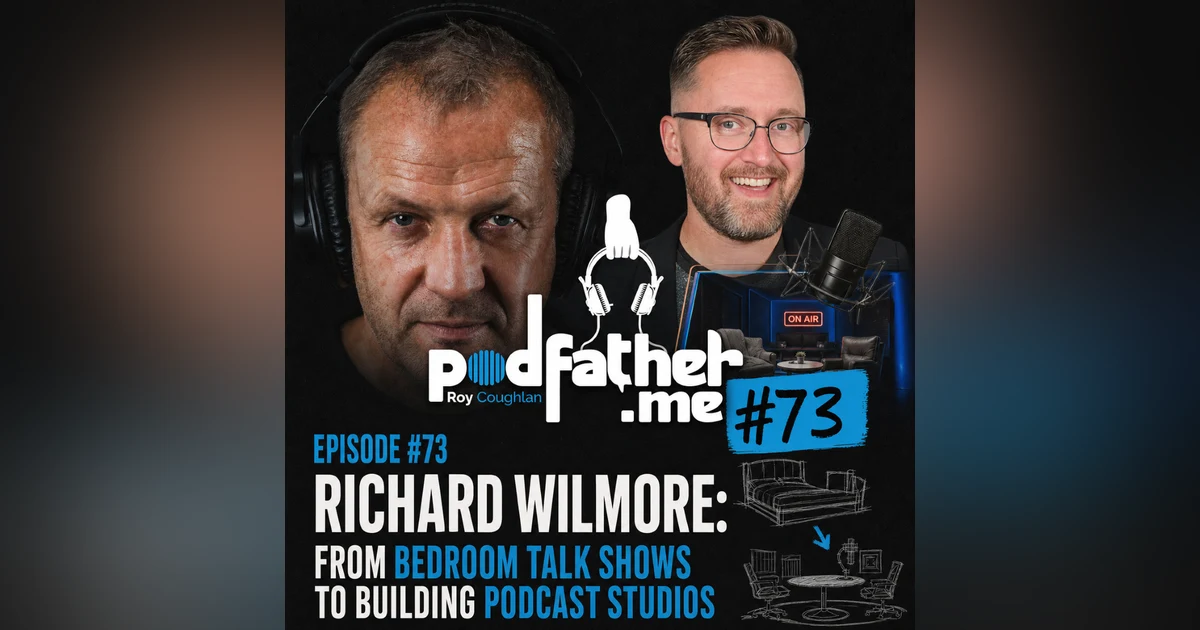
#73 Richard Wilmore: From Bedroom Talk Shows to Building Podcast Studios


 Apple Podcasts
 Spotify
 RSS Feed
 Amazon Music
 RadioPublic
 In this episode, Roy sits down with Richard Wilmore, award-winning talk show host, podcast producer, and the creative force behind Make Your Day Richer. Richard traces his 30-year journey from talking to imaginary guests in his childhood bedroom, to converting his basement into a full studio, to filming a live variety show in front of a comedy club audience with three cameras he had to edit solo. They dig into the real trade-offs between live and recorded interviews, Richard's hybrid approach using tools like StreamYard and EvieMux to make virtual guests look like they're sitting right next to him, and his surprisingly simple hack for a comfortable in-studio backdrop. The conversation turns candid on AI tools for podcasters (and why YouTube's own auto-generated timestamps beat most AI transcription tools), the ongoing debate over charging guests to appear, and the growing problem of hosts and guests who no-show or ghost without so much as a thank-you. Richard also shares his honest take on chasing "bigger" podcasts versus finding the right-fit audience, and the small production habits — clean backgrounds, no blurred-out heads, good audio — that separate a show people trust from one they don't.
About Richard Wilmore
Richard Wilmore is an award-winning talk show host, podcast producer, and the creative engine behind Make Your Day Richer. With 30 years of experience mastering the art of the interview, he brings infectious energy and a classic daytime talk-show vibe to modern digital media — whether editing top-tier content behind the scenes or pushing the boundaries of live video production in front of the camera. Beyond hosting, Richard helps other podcasters and aspiring hosts with studio setup, production, and booking guest appearances as part of their marketing strategy.
Connect with Richard:
Website: makeyourdayricher.com
Instagram: @makeyourdayricher
Facebook: @makeyourdayricher
YouTube: @makeyourdayricher
🔗 About Your Host (Roy Coughlan)
Explore more podcasts: Find all podcasts at the PodFather Network
Website: https://roycoughlan.com/
Need help running your business? If you are looking for a Virtual Assistant and get reliable support for your daily operations.
Virtual Assistants: https://va.world/
Private Networking Group: Learn about a Private Networking Group in 50 US States & 44+ Countries with 675+ Members https://connectedleaders.academy
Brain Upgrade: https://brainupgrade.org/
#PodcastProducer #TalkShowHost #PodcastTips #ContentCreation #VideoProduction #PodcastHost #PodcastGuest #StreamYard #PodcastMarketing #PodcastIndustry #PodcastLife #MakeYourDayRicher #PodfatherPodcast #PodcastCommunity #AIForCreators
(0:02 - 0:46)
Welcome to the Podfather podcast. You can find all the episodes on podfather.me. I'd like you to meet an award-winning talk show host, podcast producer, and the creative engine behind Make Your Day Richer. I'm his liability company.
He spent years mastering the art of the interview, bringing infectious energy, community, focus, and a classic daytime vibe to modern digital media. Whether he's behind the scenes, editing top-tier content, or in front of the camera pushing the boundaries of live video production, he knows exactly how to capture an audience's attention and keep them smiling. Please welcome to the show, Richard Woolman.
(0:48 - 3:45)
That's a great introduction, but I'm a little nervous to have that introduction when I'm talking to the Podfather. That feels like a little bit of pressure. I suppose off the bat, prior to recording, you've got a really colorful background.
I think it grabs people's attention straight away. When did you realize how important the background was? When I first started doing stuff like this, I always looked at them as TV shows. TV shows are so visual that it was always part of what I did to design stuff.
When people come to my studio, I do design sets for them. Everybody has their own little area that has a custom set. To me, it's part of the whole thing.
It's a whole experience, whether you're watching, whether you're the guest that comes in. It's so fun to watch people come to the studio or even virtually come on a show of mine, because they're instantly like, oh my God, where am I? What am I doing here? It just elevates everybody's mood. Excellent.
I suppose, tell us your journey into everything and into the podcasting as well. I'm about to be, well, it depends on when this comes out, but I'm about to be 42. So 30 years ago is when I fell in love with talking to people and wanting to be a talk show host is what I wanted to do.
I have been lucky enough that for the past 30 years, I've been able to do that in one way or another. I've started as just doing this exact same thing in my bedroom, talking to fake celebrities, talking to no one, but practicing that and putting on full productions without cameras, without microphones, without lights. I just loved to do it.
And then at one point, I don't know, 10 years ago, I converted a basement in my house into a studio and I would have audience members come in. I would have live bands come over and I started actually recording and putting them out there. And it kind of has snowballed into what it is today.
I've done it in a comedy club in front of a live audience for a while. I've done it in bedrooms, basements, out in the wild. I've done it everywhere.
And it's just been really fun to give people this platform to come in and break about themselves, essentially, is what I'm realizing that I'm doing. And within that, I had people see how much fun I was having and go, well, maybe I want to do what you're doing, or can I get some help with what I'm doing? And that's how the business happened. So you mentioned the comedy doing, how did you handle, like, sorry, it's when you're knowing the thing, but if there's Hector, there's always a Hector in a comedy show.
(3:46 - 5:28)
Were you recording it live and going out or were you just recording it and then had to edit it to do it? I made the, I'll call it a mistake of bringing in three cameras that I had to edit then myself into one show that I would put out there as a podcast. But it wasn't, it was a live variety show was really what it was. So it wasn't necessarily, I would have comedians on, but it wasn't a standup comedy show.
But I was filmed at a comedy club. So like, the audience knew what they were there for. And to, I didn't really have any hecklers.
And we would play games with the audience. And maybe that's where you'd have some fun with the audience. But otherwise, they were all really well behaved.
You said you treat cameras. I don't know when you're doing stuff. No, do you do that? But how much work is involved in the editing when you actually use three cameras to kind of put together the best of what you feel for the viewers? There was the reason why I started doing live shows online because it was so much work.
And I was so sick of seeing myself and so tired of hearing myself that I was like, this is too much work. Like I'm, I, it took hours, hours to put all of that together. And because it was an hour long show as well.
And so three cameras, multiple guests, multiple, because I would have audience participation. So it was a lot of moving parts. Because the three cameras weren't just stationary, they were also moving.
So it was, I don't know what I was thinking, but it was really fun. I think we evolve because I know that with, with the podcasting, I mean, at the start, I was doing loads of editing. I was like, there's no way I could do that now.
(5:29 - 10:25)
You're learning your skills as well by doing it, but then you realize what you don't like doing. And you figure out ways of actually doing it easier and better. Yes.
Yes. Yeah. I had then started doing a live stream show from the studio and had also kind of maxed out what I could do with, you know, online streaming platforms.
And I realized I was not paying attention to my guests because I was worried about what button I was going to press next and making sure the transitions were okay. And, and so I started recording them again, because I felt like I was not giving enough attention to my guests. I think that's a very important point in this way.
I, I tried doing a few lives. We did lives with about six podcasts or something, you know, between three and six, and we get really famous people on, but what it was, the person that was kind of organizing, she talked first and then she go into the back row and she was still there when she was doing all the buttons and bringing up the messages. But it's, it's still a distraction because you're still seeing it and you can't be reading something and paying attention to the guest.
And when I was doing the lives myself, it was kind of just to, because I think people, sometimes people are trying to see, will you fail? You know, they know it's live, so they're kind of going to have something go wrong here. But at the same time, if you're paying attention, like the way I was doing it as I was just concentrating on the guest and not looking at it and then people feel that they're not heard. So I know you can do it in a recording and make it look like it's live and then do all the bells and whistles.
So is that something that you're doing? Because I know a lot and I don't see anything wrong with that. I think you can serve both by doing it that way. Yeah, I started doing kind of hybrid.
So I would record some interviews ahead of time, but do a live show outside of that. So I had a, you know, part in the beginning where I was talking and an intro and all this stuff. And so some of them were live and some of them were not.
So I kind of mixed it in. So you didn't really know what was, what was live and, but I love, I love doing live stuff because even in that screw up, I haven't done live interviews in the middle of talking to someone and my camera goes down. I've, you know, like everything has happened and it really, I think helps you be better at interviewing and get better at improvising what's going to happen next.
You know, you can't plan stuff like that and you have to be okay with it going awry. I always feel bad for the guests, but the guests most of the time also kind of went with it. You know, people understand technology and I think that's part of the appeal when you're watching something live that something might happen.
You know, you can watch network television alive and stuff still goes wrong and you just kind of roll with the punches. We, I can't remember the guests, we, the famous guests, we were doing the live one and the person, the girl that I was saying, I don't know, was it an internet connection or what, but she was gone at one stage. So when the interview kind of finished, the guest left, we were just kind of, we winged it for about 30 minutes, 40 minutes because we were afraid we'd lose the recording if we just all left.
And eventually she was able to come in, but because I don't know what actually happens in that situation. Yeah. Yeah.
And you realize why TV shows have crews of 200 people making sure every little piece is working and when it's you or you and one other person, it's a lot to juggle. And I don't think we'd be allowed to get 200 interns and not just kind of play or get more gigs. No, no, I could only fit four people in this room to begin with.
So we'll just see what happens. And like, are you going out on radio then? Like what, what, what's your whole process of where you're, you know, you're doing the lives, like how are you reaching more people? When I do them, I put them on any platform that will have me and any platform that takes videos. So when I do them, they go out on podcast platforms, obviously, but they go on YouTube and TikTok and LinkedIn and Instagram, like any platform that I can put them on, I'll put them on.
And with the show then, are you like, who are you hosted with then for putting it out to say like Podbean and Spotify and the different ones? I use, for the shows that I do, because I also work for some other companies and do their podcasts, but for what I use, I use the Spotify for creators or whatever it is to kind of distribute them to podcast platforms. And then the other ones, I used to use StreamYard to record and do live streams. I now use a program called EvieMux, which is very similar.
That's been a lot of fun to use. I love that within like things like StreamYard and EvieMux, like you can be so creative in them and create your own worlds within those programs, which is fun for me. I love the creativity of it.
(10:25 - 19:46)
I think like to use the best of them, because I've seen it with StreamYard. I haven't heard of that other one that you've just mentioned, but like you can set it up in such a great way when you put the time into it to see all the benefits, but sometimes people are just hitting the record and yeah, there's different options. There's one you can share up to three platforms.
Another is to aid. And I know it goes up to a hundred bucks a month or something like that when you're going to aid. For those starting off, I know it can be a cost factor.
Yeah. Yeah. Of course.
Yeah. I do live in-person, in-studio interviews and I also do virtual ones. So I thought, how do I make it kind of look like they're similar? So when I'm doing a virtual interview, it's not completely different looking than a live in-person interview.
And so I created using StreamYard a way where it looked like the person was sitting next to me, next to my desk. And so it kind of, it just creates a whole environment as soon as the guest is there or the person watching, like I had them in like an old school TV screen. So it looked like they were in TV talking to me and I had a position where I was facing them.
So it looked like we were having a conversation and it just, I love that creativity part of it. It's so fun. That's excellent.
That's fantastic. Because I think, you know, like if we look at the CEO, diary of a CEO, like most of the shows they have an advantage when they're in the studio and unfortunately everybody can, but you've just figured out a loophole for that, which is brilliant. Yeah.
Yeah. Yeah. And I've had people on my show who have podcasts who later I would go on their show and they're like, is it okay? Cause I stole your idea for when I'm like, yeah, like it's not my idea.
Like I, you know, I'm at it. I love when I see things that are out of the ordinary in podcasting. What I love actually is, I mean, you know, cause I go on a lot of shows as well and it's sometimes the people that are new that are got very creative and they love something and you're going, Ooh, that's interesting.
Like one guy, what he did is he says, look, I'm going to be asking you this, this and this, and asked me the questions, but he said, don't answer him. So just start it off. So he basically, instead of having to go through it and get the minutes of the takes to do it, cause that's a lot of hours, like you said, and he had that.
And then we had the interview and I just thought, that's a great way of doing it because that's a time suck. You know, it's brilliant. It makes a massive difference, but it's a time suck.
Yeah. Yeah. So I, when you say that, it reminds me of shooting a movie.
Like they don't shoot a movie in order of the way you watch it. So, you know, like these are the important parts that I know I'm going to use. Let's shoot those first.
That's so smart. I might steal that. That's the beauty of it.
You know, it's like, it's good that people steal and then we're all sharing ideas with each other. Yeah. With like AI, right.
Everybody's kind of looking at ways of doing it that it will help us reduce tasks. What have you, I mean, I mean, obviously you've done a lot over the years, but no, what has saved you time with it? What has it helped you with? I have had many people who are experts in AI on my show because I don't feel like I understand it enough. And I, my problem for lack of a better word with AI is like, there's so many different things to use, so many programs to use.
And I want someone, I am the person who needs someone to go, okay, for this, you need to use this. And then you need to have this prompt. Like, I'm not good at just going out.
I'm not, people assume that I'm very good with technology, but I'm not. And so I am not good at using AI to be like, what AI program should I be using? So I do a little bit with it. I know not as much as I could, or I should to help me out in what I do, but I use it for like, I'll play games with my guests.
So I'll use it to help create a game kind of based around their niche, or I'll use it to kind of make kind of bullet points for what I do want to talk about. So I'm not completely scattered, more organizational things than, than probably the production side of it, which is probably really helpful. And you're not using it for show notes to actually can save on time on that? Oh, sometimes.
Yes. Yes. Yeah.
Yes. Knowing that I have to reread it and add things. Yes.
I've, I've learned not that to not copy and paste. And I spent ages trying to get the timestamps because I edited, I mean, I've done over 2000 episodes. I've edited them all.
And then I just said, all right, I've got 10 shows myself. Now that's not possible anymore. We don't, but I create shorts from the timestamps.
And then it was always kind of what I realized, okay, this is a good spot. And then the team would actually do it and then just put it on all my YouTube, YouTube, Bumble, et cetera, Facebook like that. But when I was using the AI, it just kept lying, getting it wrong.
And I was trying to, I tried so many things, but then it was actually one of my clients, she, she, she was like, Hey, YouTube actually gives you the timestamps when you upload it. So she was uploading it and using the timestamps for it. Smart.
I've even changed again, like turbo scrape. So that's like offer and all these different ones. And I don't know, did they change it? Cause I didn't cop it at the start.
Cause like, it's actually very reasonably priced. It's like if it's 20 bucks a month, but it's like 120 for the year. And you can actually, um, hit, give me the timestamps on that and put it into cloud.
And it's like, perfect. And I have it all the information who exactly I want it. And it does it 10 times better than I've ever done it.
You know, it's just both. You have to check it and put it in and just get everything organized. And then it works well because you know, we prefer to be in the creative zone instead of doing all these mundane tasks because they have to be done.
They spend a lot of time. Yeah. Yeah.
When I feel like I'm working too hard, trying to get AI to do what I want it to do, then I'm like, I'll just do it myself. Like that's, that's where I'm at right now where I'm like, I don't know. So I'm just going to do it every day.
And it kept lying. And I was like, why are people going on about this? But I just kept trying different sites. I key me, I tried, I chat is very good for the graphics.
So I found chat GPT, excellent for the graphics, but you have to pay from, because you know, some of them, you can be lucky. You will find a deal and you'll get it, you know, 20 bucks, whatever it is a month. Yeah.
I know they all add up, but if you look at how it's reaching people and the connections and how it's done and the time that you're saving, then it kind of, it justifies it doing it this way. Yeah. I know.
I just, it's, it's overwhelming to me sometimes because they're, it's changing and you don't know what you should be paying for and what should, you know, like you can pay for everything and then you're like, well, now what? So I need to be better at it. I know that. I think that's, unfortunately life seems to be everything is a subscription model because I've got a subscription for my printer.
And another strange thing is every time I print, I've had loads of businesses. I've always had printer problems. It just wrecked my head since I'm on the subscription.
My printer never breaks. Oh, interesting. Yeah.
Huh? Yeah. That's interesting. But if you take into account when you have to actually go and get the ink and then you got problems and everything, I kind of go, yeah, I might pay a bit more maybe, but for the, the hassle, because once it's, once something goes wrong, it always goes wrong when you need a very important documentation.
Yes. Yes. Yeah.
I'm always, I'm always fascinated when a thing that has a one job, you have one job printer. How can you not figure out how to do that? Like, why is it always a problem? So that's interesting to know that get a subscription is what we've Yes. So you've said you're on the Spotify creators.
I was on that for a lot of my shows for one stage, but with the other clients are, are they on different platforms? Because I'm always interested in like, I've used a few pod being now, um, transistor, uh, uh, Spreaker. I'm just constantly looking at them and trying to see, okay, what's good about it. And then trying to see, okay, well I move them here or new shows coming in and just curious what ones you've come across on which you found the best.
Um, all of the people that I work with are also in the Spotify world. Okay. So I've never really used, um, anything else.
I think that's the same thing where it's like, this one's better than this. Like, I don't know, I feel like you can, there's so much re like each one has its own little thing. They're all kind of similar.
Each one has something that's maybe a little bit better than another thing or not as good as another. And so that's why I just stay there. Sometimes I'm lazy.
(19:47 - 20:53)
Well, the thing is why I did it originally, as I said, they have a competitive advantage because like Spotify is kind of neck and neck with Apple. And I said, okay, that's the video elements and everything. But the problem is like, say, if you do the video on pod being or the others, if you upload the video, Spotify won't take it.
So you can only upload the audio, then they'll take it. And then if you want to do the video, you do it. But what I learned recently is if you're doing dynamic ads, when you have the video, they're not doing the dynamic ads and it's only the audio.
So we're just constantly learning. Cause you know, that's, that's how some of the podcasters are actually making some money by getting included in it, which keeps them in the game basically. Yeah.
Yeah. Yeah. You just have to always kind of be learning and be aware of, of what the updates are and what you, what you can do, like what the limits are and, and figure out what works best for you.
Yeah. Yeah. So I suppose take us through the different services that you're offering, because I noticed a lot of podcasts, listeners are aspiring podcasters as well.
(20:53 - 23:17)
I don't see this competition because it's a big world. So Yeah. I've narrowed it down to really two things.
So in the podcasting making world, I do everything from recording to editing, to putting it out there on all the platforms. I focus on, on bringing people into the studio, just cause I think that's more fun to have people here and the energy and having someone in the room with you while you're trying to create is always exciting. But I do, I have virtual clients as well.
And then I also focus on booking people on podcasts as part of their marketing strategy. So I've realized over, after doing this for so long, like people get so excited and they think that they they're so shocked that they are even asked to come on a podcast and that it's a possibility. And I don't realize that other podcasts would love to have them.
And so I'm helping people find podcasts to go on as well, which has been really fun. No, it's great. I mean, I've been, that's how I got the name, the podfather actually was a one guy.
I got him on two 50 shows and he says, Oh, you're the podfather. That was after about 50 or something. And I just went like that.
And yeah, I created a podfather podcast. But I just curious because what I'm seeing is with a few people, I think even myself, there's a lot of them, even guests. And when may, I don't think when they're paying, because they're going to more respect, although I've seen a few of them as well, that are, that are like that, that there's no shows and they're not even acknowledging it.
And it's, it's getting worse and worse. And I'm just like, I'm in, you know, I'm close with a few different people, business partners and everything. And they're not an all show, not an all show, didn't even acknowledge it.
And have you seen it increase a lot in the last few years? It was part of the reason why, beyond being like at my max for things to do during my live streams, it was part of the reason why I started recording interviews, because I was in the middle of a live show and no guests would show up. And that was happening too often, where then I started having, I started pre recording some in case someone didn't show up. And then at least I would have something to throw in there.
Yeah, and I'm seeing it on the host side as well. I've done a couple now where the host just doesn't show up, even through some of the scheduling things like Podmatch. Like, I think part of it is maybe time zone differences, people get confused, whatever.
(23:17 - 30:26)
I think part of it is there's such a low barrier of entry now to podcasting, that it's not taken as seriously as, as I think it should be when someone is expecting you to show up. Um, and I'd be curious to what your thoughts are on the whole, like, pay to be a guest, not paying, like, that kind of transaction. Because I think when you have some skin in the game, you're going to take it more seriously.
And, you know, the podcasters who put a lot of effort into having a guest on and creating a good show for you, are expecting you to also show up in return and be professional while you're here. What I've noticed is, I do, I give that option. And there was sometimes when I had such a backlog, it was the only option and I get better interviews.
They're grateful, they share it more. And I think that some people think I should be grateful because they're turning up on my stage. And you've probably seen this.
Sometimes they're just a pairing. They're there. And as you're saying your goodbyes, or you're just doing your outro, they're gone.
They're not even having a conversation. You send them all the links. They don't even acknowledge it.
They don't share it. They don't like it. They don't give a thumbs up.
But what an honor it is to have you on my show. Yes, exactly. Yeah.
Yeah. Yeah. I always say like, cause there's, there's that argument in the podcasting world about that.
And I'm like, you don't show up to target and go, you are so lucky that I've walked through your door. So I'm just going to take all of my groceries. You know, like you wouldn't, if you're putting an ad in a magazine, you wouldn't be like, you're so lucky that I even want to do this, that you shouldn't charge me to put an ad in your magazine.
Like, it doesn't make any sense to me. Like, if, if maybe the podcaster's not doing anything, giving you any content other than talking for 20 minutes, and you're, they're not promoting it, they're not doing anything, but I don't know. I work really hard to make sure my graphics are good.
I make clips. I do all, I send you all of the things, I promote them and it's, it's time. And it's to me, it's, it's professional.
It's a service. What I've noticed a few times is people, they just turn up, they're just kind of doing it for the sake of, and then when they see, like, I mean, you can see you've got a professional. I mean, when they see Kind of Mind Delighting, they then, they then just go, Oh, give me a second.
And they start getting everything ready. It's like, they just bring their A game. I find that strange that they just think, come up and just have a chit chat.
And, but I mean, if they're trying to get clients, they should be bringing their A game anyway, which a lot of them don't. Yeah. Yeah.
I don't know what the, what the mentality is around that whole, like I'm doing you such a favor for being on your show. I'm not, I'm not sure to me, it's an exchange. And I'm giving you a platform.
I'm giving you an audience. I'm giving, you know, like, I'm doing a service for you. And I don't know, I, it makes no sense.
I mean, I've even had hosts that show up with their head in a, down in the corner because they can't figure that out either. So I don't know. I, I love that people, that it's easier to create now.
And I love that, but I think it also kind of does sometimes a disservice to the podcasting industry as well. Regarding the marketing then, are you helping the clients to actually get more exposure or just putting it out there? Are you actually doing the social media as well? I, I offer that some of them already have people doing that, or they do it themselves. And some people don't.
Cause it's, it's one of the things I drive home, whether you're hosting or whether you're a guest, like it is like recording the episode is just the beginning of the entire process. You know, like I, before this, I've taken a picture already that I'll post after this, that I was on the show to tell people that it's going to come out when it comes out. Like it's, it's just part of that entire marketing machine really.
And so it's way more than just going on a podcast and then walking away and never doing anything with, with it. No, you mentioned the pod matchmen have been in pod match for years and it can work really well because you can schedule it. You can put it.
And even with the time, cause I know some people go, Oh, you got the time jump. It sets the time to where you are. I get it.
If somebody was living, in Estonia and decided to move to South America or something like that, that they forgot to change it and that can happen. But you know, everything is organized. And then even with the reviews, I mean, I post someone's review that they give me, which in turn is giving them some marketing as well as me because people go, Ooh, that's a really nice comment.
You know, so it works both ways, but a lot of people don't do it. They don't, they don't get it. Mm hmm.
Yes. Yeah. And that's not to say I've never been late for an interview or I have, or I, that it's never happened to me, but I think the the unapologetic kind of lackadaisical sometimes is, is, I don't know, interesting.
And those are usually if the host doesn't show up and just sends me a message that says, please reschedule. I think I'd rather cancel. You know, I've had guests who have not shown up multiple times and then I'm like, all right, you know, like I get it.
Things happen. I understand that. Especially for, you know, people who are busy and business owners and meetings can overlap.
And, but I think at some point you have to know when to cut your losses too. I kind of have a, I used to have a three strike rule. It'd be like, all right, third time, that's it.
But then I said, no, it's a two strike rule. I've had times where, let's say for the interviews at four o'clock, they're writing at four o'clock. Oh, I have a meeting.
I can't make it. And you're like, yeah, you kind of knew that beforehand. You know, you're just telling me no.
So yeah, you kind of have to take it. I mean, every time people, something can happen, something, you know, the child or something, that's okay. We understand it.
Why don't you acknowledge it? I mean, I've done one recently. I mean, rarely happens, maybe, I don't know, maybe four times in thousands of interviews, you know, and what usually happens, and I'm conscious of it now, is you book on the calendar and unless you accept it, it doesn't appear on your calendar. Yeah.
But I straight away then apologize. And usually they're like, okay. And then you make sure that, yeah, you're really never going to let that happen.
Other people, they get the So I get, it can happen, but all you have to do is say, listen, I'm sorry. I made a mistake. And you say, all right, fair enough.
But a lot of them, they don't even respond. And that's the end of the card. The worst thing is like for me, you know, I used to spend at least an hour.
(30:26 - 31:16)
Sometimes you could spend two hours if it was important. You're preparing everything. And then it's a no-show.
Then they don't even, because I think they're just too embarrassed to engage in conversation. And you just waste the two hours. So eventually if you've got them and, you know, you have the information, but I don't know about you when you get them the second.
The problem is you can't just pick up a piece of paper because you have to go back over it. It's not the same amount of time, but it's still more time. And I don't think they realize the amount of energy that's required to create a great interview.
Yeah. Yeah. And that it's, it's, it's not important to them.
And I think that's also, it's, I started charging guests to come on my show and some people never batted an eye, you know, they never thought twice about it. And some people would be like, that's it. That's all you're charging to give, to get all of this stuff.
(31:16 - 32:25)
And some people would pass. And I thought, okay, well, you know, that's, that, that's fine. I'm not, I don't judge anybody for not, I wouldn't be able to, if every podcast charged me, I wouldn't be able to afford to go on every single podcast.
Right. Like, so you choose what your priorities are. And I think that's, that's okay.
I just don't understand the unprofessional thought about what we do. Because you wouldn't show up, I think, and people think like, oh, well, you're not one of those, the big top five celebrity podcasts, you know, so, so you don't matter or it's not that big of a deal to you because this is just another thing to do during the day. But it's a lot of the either hosts or guests that don't necessarily have a huge following that are usually going to, I have found, will promote the episodes more because they're so appreciative of the opportunity to do it, you know, as opposed to some big celebrity or a celebrity podcast that is going to go on to the next one and not even really care that you even exist.
(32:27 - 36:04)
Like there's sometimes people that are going, what's your audience? You know, like first they're asking to come on and then they want to, I don't, I just, I know straight away, they're not coming from a place of heart, a place of giving information that, you know, it goes up. But there was one, they basically said, I think they said, oh, it has to be at least 10,000 per episode. And I just respond, when's the last time you spoke on stage to 10,000 people? And that was the end of it.
Like, you know, they don't realize if you've got, even if it's a hundred or whatever it is, that's people that are listening to the show and then they just think it's a failure. And they're looking at Joe Rogan and different ones thinking, oh, you need to get the millions and that's what's going to be successful. I mean, like you probably noticed this as well with different clients.
Sometimes they're not the biggest ones and they can get a load of sales because they've got the right message, they're on the right show and they just know how to close. There's other ones, like I know some people, they've been on a load of shows, they didn't get one sale because that's not their skillset. And then they blame the person getting them on the shows or whatever.
But it's like, you know, if you can make a sale, you will get a lot of sales. But sometimes people think just by turning up, giving the information, people are going to flock to them. You have to have a close.
Unfortunately, that's the way life is. Yeah. Yeah.
I think in our space, it's a lot of education for new people going on podcasts or podcasts hosts about what a successful show is or looks like. And, you know, I mean, there are how many podcasts out there and you can name five big ones, right? Like out of all of them. And that is like held at the top of what is a successful podcast.
And I only want to be on Joe Rogan because that's what, but Joe Rogan's not going to care about you. Like if you could go on there, it's not going to really probably do anything for you because he's going to go on to something else where if you're on shows that are in your league and in your world, those are the people that are going to care that you're having a conversation with them. I had some, a client who went on a podcast and was like, I think I'd like to be on, we need to get bigger podcasts.
And I thought, okay, well, let me see. I looked at like his social media following to see, to make sure that, you know, like it was kind of comparable. And I was like, well, the show you just went on was very comparable to, to what you have, you know, like you might want to be on bigger followings, but they could also come back and say, well, we want him to have a bigger following, you know, like, so I think it's just, what's the connection? What, what do you, what do you have to say? And what's the partnership going to look like with, with the host or the guest? Depending on what level they're at and what they're trying to achieve.
I mean, there's a higher price point and some people are like happy because they know that you're going, because there's a load of work getting people on the really high top tier ones. It's not just to get, you know, you're, you get someone pod match, but you know, if you're looking for the point ones or above, they're not on pod match and you have to have the skillset to reach them. And no, we're able to do, but it's a high price.
And some people say, great. And others are like, oh, no way. I don't want to do that.
But they don't realize, you know, by getting on this, you're going to get a return on investment. Which like, I mean, we mentioned pod match. I've used the matchmaker.fm. What are the ones that you're going to use that you thought are good? I mean, for me, pod match is the best one.
(36:04 - 37:40)
I mean, I like, I've tried a lot of different things, but have you come across any other ones that are good? I've used the matchmaker. I've used like podcast guests. I've used many of them over the years.
Back when pod match, I mean, it's never been free for anybody to use, but some of them were free back in the day. I think until pod match came out and people started going, oh, okay, we could make money from this. What I love about pod match is that it's everything is there.
It has all of your information in it. I love that it gives you access to people and that there's an understanding that we have both paid to be on this site. So there is a, I mean, I've had no shows from pod match as well, or guests that have shown up that aren't great guests.
Like I, you know, there's going to be that. But I think when, again, when you have some skin in the game, when you have put money into it yourself to be part of a community like this, I think it shows that you're a little more serious about it. What I like is the way that they're kind of helping the podcasters as well.
So guests pay more as opposed to six bucks or something for a podcaster, because they've got both accounts and, you know, it depends. I think it goes up a bit. So they keep you at the price that you came in at, but they're giving a percentage back to the podcasters, which, you know, sometimes people, you know, it's helping pay for the calendar, the Zoom.
(37:42 - 40:34)
You know, it's nice that none of the others, I don't think they're doing it. I don't think so. No, sometimes it's a little, I don't even know what it is, embarrassing, discouraging when you see like, oh, I interviewed Richard Wilmore and I made a dollar 50 from it.
I'm like, okay, well, that's all right. And that makes me laugh, but, you know, it all kind of averages out because you'll get more for some and less for some. And have you ever done like all of the Facebook groups? Have you ever tried to use those to find guests or guests? I looked at them, but I think, I don't think they're the right caliber going into them.
I think it's great if you're starting off and you're just trying to learn your trade and everything, you know, there's be a guest, find a guest and all. There's a load of them there. Have I found anyone great? No.
And, you know, they don't want you posting about what your show is about. And, you know, there's a lot of rules and regulations. And usually the people that are doing this are, it's their business and they're more trying to get you as a client as opposed to what they're telling you it's about.
So as much as it looks great, you know, Hey, I need crypto people come in and, and people both are people that are going, that don't have a podcast and want to get on a podcast for crypto. Are they going to go into groups like that? Not really. Yeah.
They used to be great. I used to use them quite a bit before Podmatch was around. And they used to be, they used to be really good groups where you would find people with, with great shows and great guests.
And it feels very ad heavy now where everybody's just kind of like not necessarily promoting a guest spot or a host spot, but like just watch my show, watch my show, watch my show. And so you don't really get a lot of connection there. And just kind of wrapping up when you're helping people kind of set up their own studio, like what mistakes do you, because I know some people, you know, they, they don't have the funds to be doing it, but they want to do it.
Like what mistakes do you see people make that they could avoid if they just kind of paid attention? I wish people would just, you don't have to have a big backdrop. You don't have to have multiple lights like I have. And I like you, but you should clean your room before you do it, please.
Yeah. You know, I think that's maybe what like people will watch and are they going to trust you? Are they going to respect you if, you know, you're sitting in front of your kitchen sink, that's full of dirty dishes? I don't know. Like just think about that.
It doesn't have to be a crazy setup. I think as long as your audio is good, your people can see you and people can hear you. I think you're good to go really like as, as a basic, let's do something.
(40:34 - 43:05)
I want to create something. I think that's the, how you start. And I think like, cause sometimes when they have the dirty background, they do the blur.
I don't think people connect with you as well. And the other thing then is they have like the beach, you know, I was, did that at one stage and I kind of cringed that I actually did that for a couple of episodes. But you see loads of people are the space and things like that.
And it's like, I don't think you're connecting with the person because I feel like really connected to you. No. Whereas if you had the space in the background, I'd know as a psychologically or what, but it's not the same.
Yeah. Yes. My, I, my cringe is when people come on and their background is extremely blurred and then half their head will go missing because it's not like they're using a green screen.
They're just, you know, and then my, I go into like, what are you hiding back there? Like, can I go in like instantly into like a, I don't a hundred percent connect or trust you because there's something back there you don't want me to see. And the other thing is when they're doing the blurred background, you know, like just say, if they're showing you their book or something, they hold it up, it disappears. And they're like trying to show you something and you're like, I don't see it.
So the rest of the people don't see it either. I know. I feel I, you know, some people I feel just bad for, um, cause they don't know, you know, um, and they're, they're doing their best, but it is one of, I, I, um, hate a blurred background.
Yeah. Cause I want to see you, you know, I want to see you and I don't, it's, it's odd when we're talking and half of you is missing or you put up your arm and you don't see it or a book or whatever it is. It gets, it's weird.
So, well, what I would encourage if people were just listening to this to actually going bit to YouTube or rumble where they can see Richard's background, cause it's actually, you know, it's really nice. So listen, totally enjoyed it. You might let the listeners know where they can find you.
Uh, makeyourdayrichard.com is where everything kind of lives. Nice and simple. Yeah.
Try to make it all easy for people. Yeah. Yeah.
Excellent. I'll make sure I put the links, put the audio in the video. Thank you very much.
Thank you. That's all for the Podfather. You can find all our episodes on podfather.me. You find everything about me, scan the QR code or go to roycoughlan.com. And if you're looking for virtual assistants, go to va.world. Be sure to give us a thumbs up, five star rating, maybe share with three friends, and when you check out Richard's, do the same thing.
Really helps. Until next week, take care.

PodPreneur
I started Podcasting in 2018 and now I am a Podcasting Coach with 6 Podcasts. My Podcasts are Speaking with Roy Coughlan ,Awakening , Meditation , Learn Polish, the Crypto Podcast and this new one PodFather. 4 have gotten into the Top 0.5% with the 5th currently at 1%. I have yet to find someone else who has done this.
I help clients get on the Top Rated Podcasts to promote their business or book.
I work with those starting a Podcast or existing Podcasters trying to grow their audiences.
I have produced and edited over 1,200 Episodes include over 100 live with top guests like Miki Willis, David Icke, Thomas Renz, Dr. Peter McCullough and more